Chaitanya Kalbag on the “cess pool” of state elections

Chaitanya Kalbag has a nice column in today’s Economic Times about whether the issue of corruption will figure at all in the upcoming five state polls due to kick off in February. Uttar Pradesh, of course, is the prize everyone has their eyes on. But there are several states of consequence that will go to polls in the next few weeks: in addition to UP–Punjab, Uttarakhand, Manipur, and Goa.

Kalbag is rightly skeptical that Prime Minister Modi or any other major political leader will take serious steps to cleanse what he calls “India’s political cesspools.” Kalbag very graciously cites my forthcoming book to justify his skepticism:

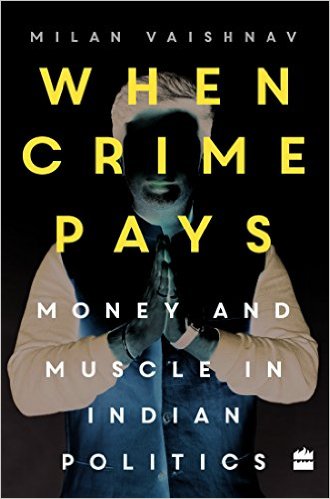
“Just as markets feature intermediaries who match buyers with sellers, political parties have embraced and promoted candidates with criminal links, drawn to their deep pockets at a time when the cost of elections has exploded and party organizations have atrophied,” writes Milan Vaishnav in ‘When Crime Pays: Money and Muscle in Indian Politics’, to be published this month. Vaishnav, a senior fellow at the Carnegie Endowment for International Peace, adds: “Loophole-ridden campaign finance laws have been no match for the torrent of undocumented cash that those with criminal ties are able to marshal.”

The whole piece is worth reading. You can find it here.
New op-ed: “Purify the Parties”

In a special New Year’s Eve address, Prime Minister Narendra Modi once again reiterated his desire to see election finance reform in India. This has been a regular theme in the PM’s speeches, dating back to the 2014 general election campaign. However, Modi’s rhetoric has intensified in the days and weeks following his government’s November 8, 2016 demonetization decision.

In the speech, Modi said:

Political parties, political leaders and electoral funding, figure prominently in any debate on corruption and black money. The time has now come that all political leaders and parties respect the feelings of the nation’s honest citizens, and understand the anger of the people.

It is true that from time to time, political parties have made constructive efforts to improve the system. I urge all parties and leaders to move away from a “holier than thou approach,” to come together in prioritising transparency, and take firm steps to free politics of black money and corruption.

All of this is well and good, but the PM unfortunately stopped short of outlining a detailed agenda for reform. In a new Indian Express column, I outline a four-point reform proposal that I argue Modi should adopt immediately. It would begin to cleanse India’s system of political funding while also placing the opposition on the back foot. In the piece, I write:

While we will continue to debate the merits of demonetisation, the government has repeatedly signalled it will stay the course. The question is: Will it eventually summon the same fortitude when it comes to closing the loopholes from which political actors derive undue benefit? Fresh moves aimed at the political class will inevitably create disruption, including for the ruling party, but it will engender massive popular support. It will show the entire country that no one is truly immune from the cleansing. The ball is in the government’s court.

You can read the piece in its entirety here.

What India Taught Me About Trump

An outsider runs for political office in a hotly contested election. He has a closet full of skeletons the conventional wisdom views as a liability, but he regards as an asset. He preys on distrust of the government, vowing to obliterate “politics as usual.” Against a backdrop of demographic change and economic disruption, the candidate exploits a once-dominant group’s fears of being left behind. His behavior may be unorthodox, but it is authentic and even reassuring to his base.

Sound familiar? While this quote could characterize U.S. President-elect Donald Trump’s rise, it could just as easily describe many of the “non-traditional” (criminal) politicians I researched for my book. As I write in a new column for the Diplomat, their “playbook is strikingly similar to the one Donald Trump executed with aplomb to win the 2016 U.S. presidential election.”

You can read the full piece here.


Pratap Bhanu Mehta’s 2016 Reading List

There are few things in life more enjoyable than finding out what is on Pratap Bhanu Mehta’s bookshelf. Granted, reviewing the list makes one feel (at least makes me feel) seriously under-read. But the list is nevertheless full of gems, some hidden and others not. Pratap has some kind words for my new book, When Crime Pays, but focus instead on the slew of social science books on India he has rounded up.

Here’s the relevant paragraph:

But this year, the most significant books also happen to be written by friends and colleagues. They are so compelling that one has to put aside the awkwardness of mentioning friends. So, with this full disclosure, it was a joy to read my colleague Srinath Raghavan’s India’s War (Penguin) about a breathtaking intervention in Indian history; Vinay Sitapati’s Half Lion (Penguin) started a serious scholarly debate on Narasimha Rao; Shiv Shankar Menon’s Choices (Brookings) is Indian foreign policy thinking sober, not drunk. Devesh Kapur, Nirvikar Singh and Sanjoy Chakravarty’s The Other One Per Cent (Oxford University Press) is not just the best study of Indians in America, it has profound implications for understanding India’s elites; Nandini Sundar’s The Burning Forest: India’s War in Bastar (Juggernaut) is a reminder of how awfully our states can fail. Just as the year was ending, Milan Vaishnav’s magnificent When Crime Pays: Money and Muscle in Indian Politics (Harper Collins) arrived. This book examines why we vote for criminal politicians. Prerna Singh’s How Solidarity Works (Cambridge) has won more social science awards than any recent book in American academia; it asks, is sub-nationalism good for service delivery? For stimulating ethnographic and meditative reflection on moral lives, it was rewarding to engage with Bhrigupati Singh’s Poverty and the Quest for Life (Chicago).

You can read Pratap’s entire piece here.


Interview with Democracy Audit UK

I did an interview this week with Democracy Audit UK, a research organization focused on democracy and housed at the London School of Economics (LSE), on my forthcoming book, When Crime Pays:  Money and Muscle in Indian Politics.

Here’s a snapshot:

A candidate with criminal allegations hanging over them will repel voters – or will they? Not necessarily. In India, a third of the MPs elected in 2014 faced an ongoing criminal case. Milan Vaishnav, the author of a new book about the nexus of crime and democracy in India, talks to Ros Taylor about the appeal of a strongman who can ‘get things done’, even if it means breaking the law – and considers whether some US voters share the same instincts.

You can read the whole interview here.

A (brief) preview of my new book

Nearly every month, the terrific journal, Governance, leads with a summary of a forthcoming book pertaining to democracy, governance, or public administration. For their October issue, the journal carried a short essay of mine on my forthcoming book, When Crime Pays: Money and Muscle in Indian Politics.

The piece, entitled “Why Voters Sometimes Prefer Criminals as Candidates,” outlines the rational reasons for which voters in India (and elsewhere) decide to support a candidate with a serious criminal reputation. In contrast to the prevailing wisdom that such backing is due to a lack of information, I find that voters quite willingly lend their support to such political figures–with eyes wide open.

Here’s the key paragraph:

In settings where two conditions are operative—weak or unevenly enforced rule of law and highly salient social divisions—politicians can use their criminality to signal their credibility when it comes to protecting the interests of voters in their constituencies. This “protection” typically involves substituting for a state administration that is unable (or unwilling) to effectively and impartially fulfill its basic functions, such as guaranteeing public security, adjudicating disputes, and providing core public services. The “interests” of constituents that politicians pledge to protect are often cast in terms of preserving the status of their social (often ethnic) community. This allows a politician to spin his willingness to run afoul of the law as a necessary qualification for “defending” his community.

If you are interested in learning more, you can read the full piece here.

Demonetization and India’s Money Politics

There have been countless op-eds written in the last three weeks in reaction to India’s dramatic “demonetization,” in which the government invalidated high-denomination currency overnight in an attempt to curb the scourge of black money.

One important angle worth thinking about is how the move impacts India’s murky system of election finance. I have a piece on the Financial Times’ “Alphaville” blog looking at this issue. Here’s the upshot:

Will this demonetisation move sound the death knell for dirty money? On its own, not a chance…If Modi is serious about addressing India’s unseemly money politics, he must take at least three reinforcing actions.

What are those reinforcing actions? In short, closing political finance loopholes; tying tax breaks to political parties with new transparency standards; and directly attacking the underlying drivers of India’s black economy.

You can read the full piece here.


Pre-order “When Crime Pays”

For those who are looking for a suitable holiday gift for your politics-obsessed friends and family, the U.S. edition of my book (via Yale University Press) is available for pre-order through Amazon. In the coming days, I will post details about the India edition, which will be published by HarperCollins India.

yale_preorder

More details about the book, including pre-order information, can be found here.