Here is the audio from our June 2 Carnegie Endowment event with Oxford’s Vijay Joshi and Subir Gokarn of the IMF on the former’s new book, India’s Long Road: The Search for Prosperity.
Sarthak Bagchi reviews “When Crime Pays” for The Book Review
Sarthak Bagchi has a very thoughtful review of When Crime Pays in the latest issue of The Book Review. Bagchi’s review is titled, “Of Bahubalis of Indian Politics” and he calls the book:
…a must read for students, researchers and scholars who want to understand the crime and politics question better among other puzzles of Indian democracy.
You can read the entire review here.
June 2 event with Vijay Joshi
On Friday, June 2, we are hosting Oxford University economist Vijay Joshi at Carnegie. Vijay will be talking about his recent book, India’s Long Road: The Search for Prosperity. I am nearly done with the book and it is an excellent analysis of what ails India’s economy and the fixes that should be applied. Martin Wolf of the FT is also a big fan. In a recent review, he writes:
While the focus of India’s Long Road is on the economy, its analysis is appropriately comprehensive. It considers the post-independence growth record, the failure to create remunerative employment, the excessive role of publicly owned enterprises, the poor quality of Indian infrastructure and the inadequacy of environmental regulation. The book also analyses the successes and failures of macroeconomic management, the appalling quality of government-provided education and healthcare, the need for a better safety net for the poor, the long-term decay of the state, the prevalence of corruption and the role of India in the world economy. In covering all these issues, Joshi combines enthusiastic engagement with the detachment of a scholar who has passed much of his life abroad. No better guide to India’s contemporary economy exists.
You can register for Friday’s event here. Subir Gokarn, India’s executive director to the IMF, will also be on hand to discuss the book.
Carnegie Podcast on “Rethinking Public Institutions”
Devesh Kapur, Pratap Bhanu Mehta, and I had the chance to sit down with Tom Carver to record an episode of the Carnegie Endowment podcast. The conversation was wide-ranging, touching on many of the themes of our recent edited volume, Rethinking Public Institutions in India.
You can listen to the podcast here.
“Public Institutions” excerpt in Mint
Today’s edition of Mint features a brief excerpt from the introductory chapter to our new volume, Rethinking Public Institutions in India. The chapter, co-authored by Devesh Kapur, Pratap Bhanu Mehta, and myself, outlines the nature (and immense importance) of the state capacity challenge India faces.
Here’s a taste:
Unfortunately, all this makes it painfully evident that India is struggling to perform even the most basic functions of a sovereign state. While much of the attention on the manifold shortcomings of the Indian state has focused on high levels of corruption and venality in public life, an equally compelling limitation is the lack of competence, both at the policy design and formulation level, and the even larger challenge in effectively implementing these policies.
You can read the full piece here.
“Rethinking Public Institutions in India” out now
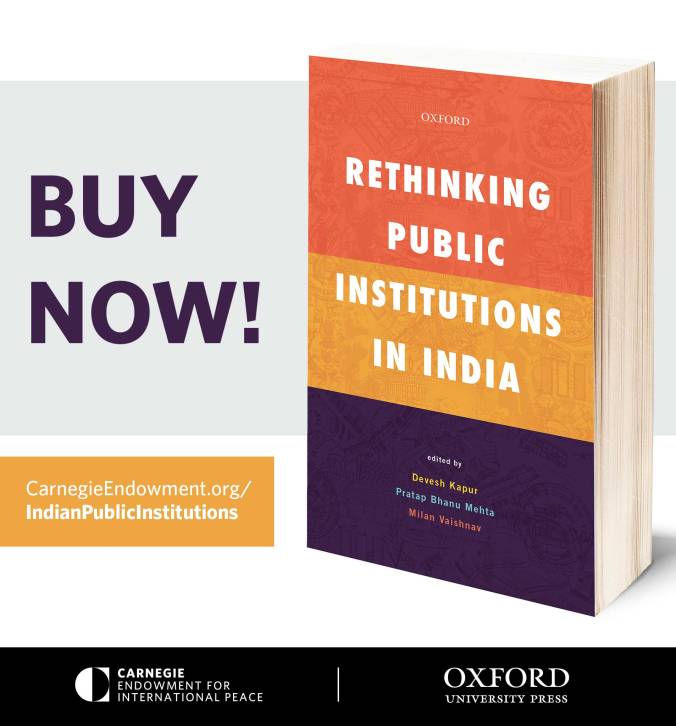
Our new edited volume on the Indian state is now available for purchase. Our hope is that it will be a “one-stop shop” for those looking to understanding the state of governance in India.
The book builds on the essential 2005 volume on the same theme edited by Devesh Kapur and Pratap Bhanu Mehta. We thought, after ten years, it was worth taking stock once more not to mention studying institutions that did not figure in the earlier book (such as the Election Commission of India)
You can find out more about the book here (including links to our introductory chapter + my co-authored chapter — with E. Sridharan — on the Election Commission).
Ashutosh Bhardwaj reviews “When Crime Pays” for the Financial Express

Ashutosh Bhardwaj has a nice review of When Crime Pays in today’s Financial Express. He begins with this anecdote about Sibgatullah Ansari, brother of noted don-politician Mukhtar Ansari, currently an MLA in Uttar Pradesh:
On a night of May 2014, days before the Lok Sabha polls, a bewildered Dalit man entered a palatial haveli in Mohammadabad town of Ballia district in eastern UP. His eight-year-old daughter had been raped, but the police were refusing to file a complaint. Seated on a sofa, Sibgatullah Ansari dialled a number, talked to the cops, seeking immediate action, and dished out a `500 note to the man. “Ja, kuch kha lena. Fikra na kar (Go and eat something. Don’t worry).” This writer was witness to the incident when the tall man dispensed justice, underlining the irony of Indian electoral politics.
The entire review is worth reading as Bhardwaj touches upon some of the (oft-forgotten) historical roots of the criminal-politician nexus. You can read the full review here.
May 3 Carnegie event with Adam Roberts
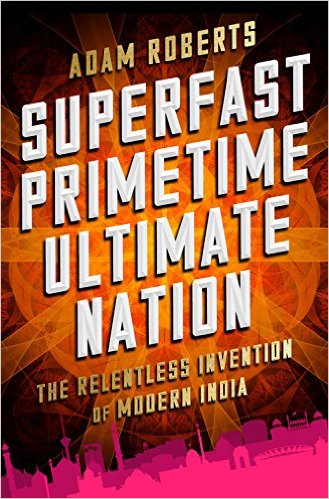
I am really pleased to have the chance to sit down with Adam Roberts of the Economist on May 3 at Carnegie. Adam, formerly the paper’s South Asia correspondent, and I will be discussing his new book: Superfast Primetime Ultimate Nation: The Relentless Invention of Modern India.
There will be a reception and book signing to follow. All are welcome. To RSVP, click here.
FirstPost review of When Crime Pays
Manik Sharma has written a review of the book for FirstPost. I also had the chance to speak with Manik about some of the book’s main themes.
Here’s his final para:
Though there are clear signs as to where the Indian system ails, there are no clear signs of it being treated. Criminality has simply become too entrenched. And therefore it takes a book like When Crime Pays, and a hovering gaze to make sense, and question with renewed intensity, the state of our country’s politics. When Crime Pays is perhaps even more important for those who wish to ignore it, than those who will readily devour its uneasy findings.
Read the whole thing here.
A friendly request to readers

It was really gratifying to see this list this morning courtesy of my publisher, HarperCollins India. If you’ve had a chance to read the book, THANK YOU.
And now for a request: please leave a review of the book on Amazon. Whether you loved it, hated it, or were indifferent, it would be great to hear from you.
Here’s the link to the Amazon (US) page and the link to the Amazon (India) page.
Thanks,
Milan
 Milan Vaishnav