Podcast: I Survived “Cyrus Says”

17835040_1686715881621483_8132026406646150097_o

When I was in Bombay in February, I recorded a podcast with funny-man Cyrus Broacha for his “Cyrus Says” podcast. The recording was a hoot although, as you can tell by listening, I struggled to keep up from the moment we started recording.

Cyrus and I talked about my childhood, my book, the city of Delhi, Donald Trump, Narendra Modi, and everything in between.

The podcast is out now and you can listen to it here.
 

Crime, intimidation, and politics

That’s the title of a recent review of When Crime Pays by Atul K. Thakur in the Kathmandu Post. Thakur calls it “a book that is extraordinary and purposeful—which despite being centred on Indian politics is universal in its application.”

But the author also raises a few quibbles with the book that are valid and useful. The first is that the book does not delve into “the misuse of media or of public relations during elections.” Thakur writes:

Never in the history of parliamentary democracy has conventional and new media been misappropriated as it is now. In a world ruled by opportunists, truth continues to be distorted beyond recognition, influencing voters with an avalanche of non-issues instead.

Thakur’s second critique is about the very nature of criminality:

[T]he definition of “crime” in itself needs to be revisited, as modern-day crime is so well-organised and thoroughly proofed that merely classifying it as “money and muscle” only paints half the picture

Thakur’s review is well worth reading. You can find it here.

“When Crime Pays” reviewed in The Wire

Over at The Wire, Raghunath Nageswaran has a review of “When Crime Pays.” He begins with an excellent quote from the sociologist Max Weber:

“There are two ways of making politics one’s vocation: either one lives ‘for’ politics or one lives ‘off’ politics,” said German sociologist Max Weber in his essay ‘Politics as a Vocation‘. Surely, many politicians have come to live off politics but what are the ‘incentives’ that encourage individuals soaked in criminality to take the plunge into it in the first place? At a time when we are witnessing increasing criminalisation of politics in our democracy, this question needs to be confronted head on and that’s precisely what Milan Vaishnav sets out to do in his book When Crime Pays: Money and Muscle in Indian Politics.

You can read the entire review here.

Vir Sanghvi’s review of “When Crime Pays”

Vir Sanghvi has a review of When Crime Pays for the Business Standard. Here’s a brief snippet:

Vaishnav argues persuasively that the criminalization of Indian politics has many causes. In rural India parties need organizations. It is easier to co-opt local dadas and their gangs than to build new party organizations. Many of the criminals also have money. Parties are happy letting them finance their own elections and grateful for whatever money they donate to the larger campaign.

But there is also a fundamental failure of Indian democracy. The reality is that as loathsome as these criminals may be, people do vote for them. They continue to win elections. Even if the likes of [Narendra] Modi and Nitish [Kumar] are sincere about ridding politics of criminals, they need the goondas because we, the voters, like them enough to keep voting for them.

You can read the entire review here.

New op-ed: the Finance Bill and transparency in political funding

With the passage of the Finance Bill 2017, India has taken a significant step backwards in the fight to improve the level of transparency in political finance. In a new column for the Hindustan Times (and Mint), I take a look at the fine print:

The big loser here is the public. With the stated intention of improving “transparency in electoral funding,” the government has accomplished precisely the opposite objective. Consider the fact that corporations can now legally give unlimited sums to political parties who, in turn, can accept unlimited sums of money—all without having to disclose a single rupee. This money will now be subject to a digital paper trail, but this is explicitly meant to be off-limits to the media, civil society, and the general public.

You can read the entire piece here.

What did recent state elections tell us about the crime-politics nexus?

I have a new column for NDTV on the crime-politics nexus in the wake of India’s five recent state assembly elections. While some commentators have been heartened by what appears, at first glance, to be an overall decline in the share of legislators with criminal records, there are good reasons to treat this data with caution.

Here’s a snippet:

One should not extrapolate too much from one data point. The observed decline in Goa and UP might simply suggest a reversion to the mean. In UP, for instance, 35 percent of MLAs were named in criminal cases in 2007, which is roughly the current level. The same is true in Goa, where the share in 2007 is identical to today’s share (23 percent). In both states, 2012 saw a jump in the proportion of MLAs facing cases.

You can read the entire piece here.

New essay: “Modi’s Victory and the BJP’s Future”

In a new piece for Foreign Affairs online, I take a look at the BJP’s crushing victory in the Uttar Pradesh assembly elections and what it means for India’s political landscape. In addition to winning UP, the BJP also formed governments in Goa, Manipur, and Uttarakhand.

Here’s the punchline:

For now, Modi and the BJP can bask in the afterglow of a major electoral achievement. No party has vanquished its rivals in UP in this manner in 40 years, and that too was in the wake of Indira Gandhi’s disastrous Emergency Rule. Judged against the very high bar of its 2014 national performance, the ruling party’s standing has held up reasonably well. The BJP, in extremely short order, has remade itself in the image of Modi. As the case of Gandhi reminds us, such a strategy is laden with long-term risk. But in the short term, the party has decided to ride the wave.

You can read the full piece here.

Video: Book discussion on “Rethinking Public Institutions in India”

On March 10, we held a discussion in New Delhi around some of the key themes in our forthcoming edited volume, “Rethinking Public Institutions in India.” The book is edited by Devesh Kapur, Pratap Bhanu Mehta, and me. It features contributions by some of the best political and economic thinkers in and on India.

The discussion, which began with some introductory comments from Devesh and Pratap, featured an all-star panel: Arvind Subramanian, Montek Singh Ahluwalia, Shailaja Chandra, Jay Panda, and Yogendra Yadav.

You can watch video of the entire event here.

Book discussion: “Rethinking Public Institutions in India”

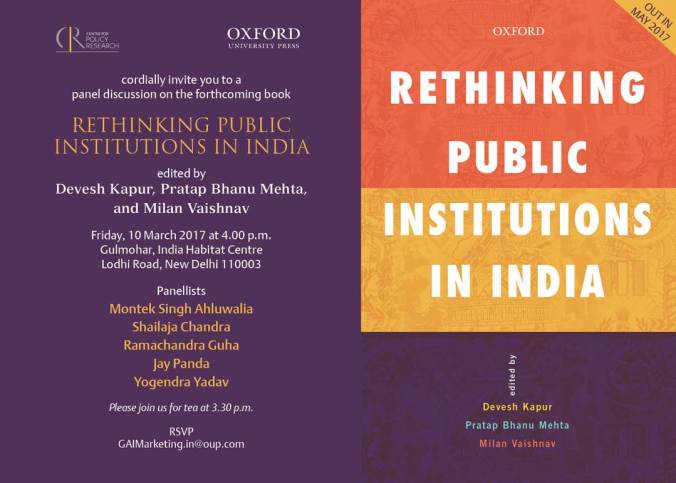
I’m excited to announce that an edited volume I’ve been a part of will be coming out this May via Oxford University Press. The book, “Rethinking Public Institutions in India,” is co-edited by Devesh Kapur, Pratap Bhanu Mehta, and me. The book revisits some of the themes first explored in the 2005 volume, “Public Institutions in India: Performance and Design,” also edited by Devesh and Pratap.

Here’s a preview:

While a growing private sector and a vibrant civil society can help compensate for the shortcomings of India’s public sector, the state is—and will remain—indispensable in delivering basic governance. In Rethinking Public Institutions in India, distinguished political and economic thinkers critically assess a diverse array of India’s core federal institutions, from the Supreme Court and Parliament to the Election Commission and the civil services.

Relying on interdisciplinary approaches and decades of practitioner experience, this volume interrogates the capacity of India’s public sector to navigate the far-reaching transformations the country is experiencing. An insightful introduction to the functioning of Indian democracy, it offers a roadmap for carrying out fundamental reforms that will be necessary for India to build a reinvigorated state for the twenty-first century.

If you are in Delhi on March 10, we will be hosting a book discussion with an all-star lineup of panelists. More information below:

Delhi launch hi-res

“When Crime Pays” now out in the UK

As of today (March 7), “When Crime Pays” is now available in the UK and Europe via Amazon UK. You can find the book here.

Thanks to all of you who have written to me with your feedback and comments. If you have a spare minute, please do leave a review (good, bad or ugly) on Amazon.

You can find a complete list of reviews in the media here.